October 09, 2013
Dear President Obama Re: Government shutdown/debt limit
I am very concerned about reports that you are considering "negotiating" with the Republicans. You have done well, so far, responding to Republicans taking the government hostage. Much better than in previous instances. Experience shows us that if you give in to any of their unreasonable demands, and they are all unreasonable, that they will take that concession and wait for the next opportunity to replay the whole scenario. The only way to stop this cycle is to hold firm to your position. Negotiations either before or after ending the shutdown or extending the debt limit will only encourage them to continue their destructive tactics.
The press reports that there are enough moderate Republicans who are willing to re-open the government and extend the debt limit. You should make it clear that you are not going to budge and encourage them to take action to end this now.
The budget that is finally passed should not take away from those most in need, or cut Social Security or Medicare. These programs are the most efficient and beneficial in the entire Federal Government.
We should not cut regulation to protect our health, our environment or our economy. Well enforced regulations level the playing field, which is now tilted to favor those who would cut corners or throw their costs onto the public.
On the other hand, we could easily cut our bloated, corrupt and wasteful military and "National Security" programs without endangering our security one bit.
Republicans are being unreasonable and do not deserve serious consideration of their demands. The public is with you and will demonstrate that in the next election if you show some spine and stand up to these hooligans.


May 05, 2012
B of A Misdeeds
Your B of A – Lessons
Learned
Under the guise of B of A
repenting, a good summary of misdeeds.
This whole website is written as if Bank of America was being nationalized and reformed. So, B of A would now be Your B of A.
I especially like this page, where all the banks past transgressions are reported (well, maybe not ALL).
Lessons Learned
Today, we at Bank of America
are turning over a new leaf. Your Bank of America will be a Bank for America.
And much as we would show an incoming CEO our full balance sheet, giving him or
her the full knowledge needed to chart a new course, we are committed to
transparency with you as well, and to displaying for you our liabilities as
well as our assets.
Claim liabilities
We will, naturally, vigorously defend
ourselves in any and all of these cases and any others that may arise, so long
as we remain in command of our destiny. Still, it is obvious that this volume
of litigation will at the very least present a challenge for those seeking to
make positive business changes.
Investors claims
Our Bank is today
facing over a dozen major lawsuits for selling fraudulent securities to
institutional investors. Though we have settled for $8.5 billion in damages
with one such group
of investors, we still face a further $10 billion in similar claims from AIG,
and $700 million more from Allstate, as well as a fraud suit for just over $1
billion by U.S. Bancorp.
Insurer claims
We are being sued
for $1.4 billion by a major bond insurer, MBIA, which claims it was
fraudulently induced to insure worthless Countrywide mortgages. Another bond
insurer, Assured, is seeking $1.6 billion in damages in a very similar suit.
Additionally, Ambac, an insurance company which is now bankrupt, claims it lost
$466 million as a result of fraud by our Bank.
Pensioner claims
Last year, we
settled for $624 million in a case that claimed we had knowingly sold in
fraudulent securities to New York public pension funds. We also settled for
$315 million in a case involving the Mississippi state pension fund. Similar
cases from other states are unfortunately in the pipeline.
Depositor claims
A federal judge
ruled in May that Bank of America had systematically overcharged depositors
with inflated overdraft fees, forcing us to pay more than $410 million in
damages.
Federal Government claims
A federal case
alleges that our Bank sold over $3 billion of worthless securities to Fannie
Mae and Freddie Mac. The settlement in that case is pending.
Minority claims
Earlier this year we
paid $335 million to settle claims that Countrywide had systematically sold
minorities riskier adjustable “sub-prime” loans when they were, in fact,
well-qualified for safer, fixed-rate mortgages.
Homeowner claims
Our Bank faces over
a dozen class-action suits alleging improper foreclosure on thousands of
homeowners, some even alleging perjured, "robo-signed" evidence. We
have also been accused of deliberately slowing down mortgage modification
claims to avoid having to comply with programs to aid distressed families,
requirements imposed on us as one of the largest recipients of 2008 bailout
funds.
County and town claims
Dozens of
localities are alleging that Bank of America systematically evaded hundreds of
millions of dollars in local taxes by using MERS, an electronic mortgage
registration system that allows the avoidance of county-level
mortgage-registration fees.
Shareholder claims
After purchasing
the ailing Merrill Lynch with taxpayer funds, bonuses we paid Merrill
executives—in order to ease the merger approval process—came into question and
became the subject of a lawsuit. While we agreed to settle with the S.E.C. for
$33 million, a judge later quadrupled the fine to $125 million to resolve the
claim of fraud.
Other direct liabilities
Inherited liabilities
After acquiring
Merrill Lynch in 2009, along with its assortment of debt, toxic assets, and
junk investments, Bank of America has found itself beset by thousands of
complaints, class action lawsuits and even criminal charges brought by over a
dozen state attorneys general. In 2011 we paid out $5.6 billion in
litigation-related expenses, up from $2.6 billion for 2010. In 2012 those costs
are likely to continue to rise; in the first quarter of 2012 alone, for
example, Bank of America has committed to a $3.25 billion payout to the federal
government to satisfy a multi-state settlement in the fraudulent “robo-signing”
fiasco.
Service-charge reductions
A significant share
of our annual income is derived from the various service charges contributed by
our customers. Last year, service-charge revenue decreased by almost $2
billion, due to a populist “move your money” campaign which included a
highly-publicized internet petition. The aggregate effect has been devastating
to a core node of our business, and makes clear the need to rethink a model
that needs to sustain high overheads through such a wide variety of means.
Indirect liabilities
These are, essentially, factors that
make our Bank unpopular with the general public, and increase the difficulty of
doing business. These do not have a direct effect on our bottom line, but may
accentuate other effects—for example, by creating a hostile judicial environment
in which non-objective judges more readily accept claims against us.
Taxation issues
Due in part to our
continued losses, and the compensation imbalances outlined above, Bank of
America paid no federal tax for 2011, just as in 2010 and 2009. Part of this
can be tied to the immense complexity of our business and the global nature of
our client base, which has necessitated the creation of hundreds of foreign
subsidiaries, including many in traditionally tax-averse territories, such as
the Cayman Islands. It is also largely due to the ongoing efforts of our
world-class legal team. But regardless of the reasons, this great asset has,
with the advent of a more politicized public, become a liability. Many more
people have come to resent the fact that the bank with the most branches,
customers and checking accounts of any US bank pays no federal income tax, and
that public brand-tarnishing presents unknown risk. Even more, the fact that
even without taxes, we still don't turn a profit leads many to suggest that our
business model is fundamentally flawed.
Embroilment in the foreclosure
market
The
Bank of America never intended to become a used-home dealer. By finding
ourselves in a foreclosure-mill of unprecedented size, our Bank has come to
take charge of a vast stock of underwater homes that in many cases remain
vacant, eventually bringing the value of entire neighborhoods down. Perceived
abandonment of foreclosed homes, coupled with heartbreaking images of
evictions, has perpetuated a vast reservoir of ill-will about our brand which
also presents a hard-to-assess bottom-line risk. It has also created a platform
for critics, who have even gone so far as to engage in stunts that distort the
facts, like when one irate Florida mortgage holder, who had won a small court-ordered
financial judgment against our bank, mobilized their local sheriffs department
to “foreclose” on one of our branches in order to collect their judgment.
Environmental liabilities
unpopular
Part of our Bank's strength has come from our predominance
within key industries. From 2009 to 2010, for example, we invested more than $4 billion
in coal, more than any other bank. This has led some to claim
that we are responsible not only for exacerbating the global climate crisis,
but for contributing to thousands of deaths due to cardiac and respiratory
diseases, as well as 1.6 million lost work days due to heart attacks, chronic
bronchitis cases, asthma attacks, and the like.
Inequality
Finally, in this
time when the issue of "inequality" is so prominent for Americans,
much has been made of the contrast between our stock losses (40% in 2011) and
the year-end compensation of our senior executives (7% more than the year
before), as well as in the contrast between our CEO's rate of earning and that
of a typical teller (441 times more). Regardless of the merits of these points,
they do appeal to a wider and wider swath of the American public, creating a
deficit of good-will about the brand, which also exposes us to bottom-line
risk, especially in the retail banking sector.
Summary
Some
of the issues we have outlined above will be easier to address than others.
Some may even disappear on their own should there be a federal receivership
process, thus it may be premature to worry about them now. But we are committed
to demonstrating showing you that we have changed. We wish to provide you, the
American taxpayer—who even own our bank in the near future—with the information
you are likely to need in pursuing success of the sort you're defining. That
was then. This is now. Your Bank of America.
January 28, 2012
Slavoj Žižek speaks at Occupy Wall Street: Transcript
This summary is not available. Please
click here to view the post.
November 17, 2011
Tents
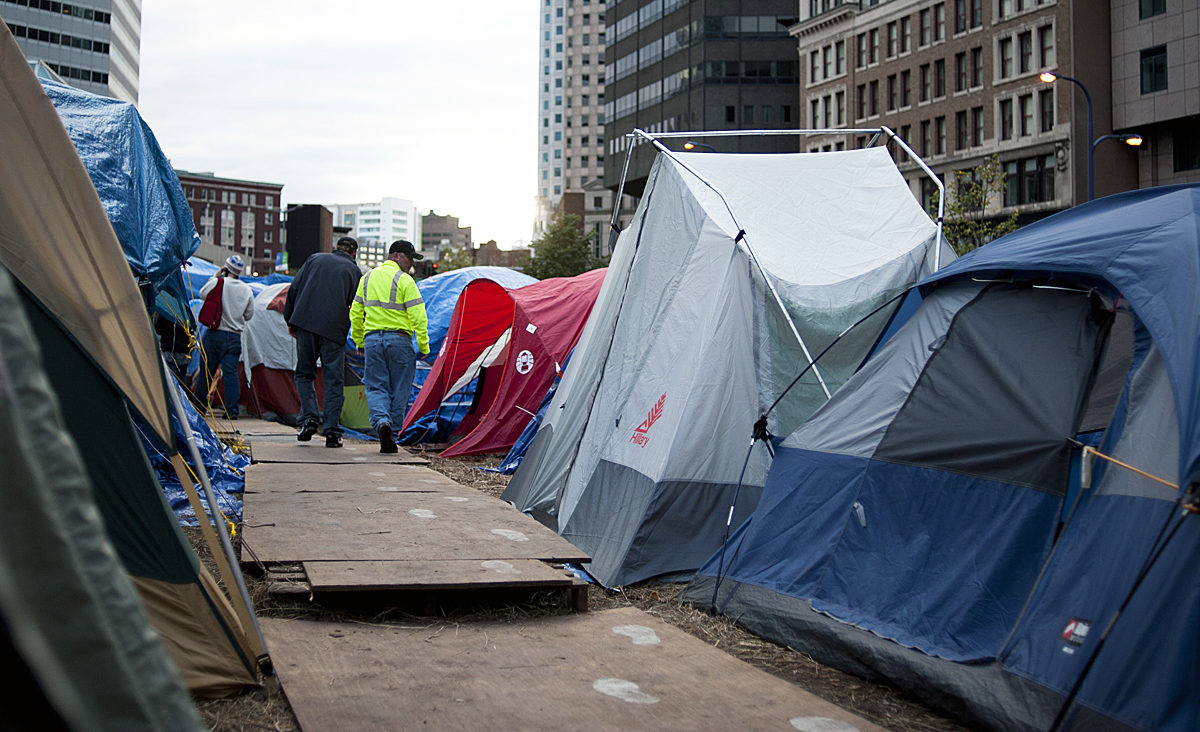
The law, in its majestic equality, forbids the rich as well as the poor, to sleep in the parks –Paraphrased from Anatole France
Police attacks on Occupy movements from Wall Street to
Oakland, Portland, Denver … have often been justified by the “need” to prevent
the use of tents or shelters in public places. Of course, we know that the real reason is that the powers
that be don’t like the political and social views that are being expressed by
the Occupations.
We’ll get back to tents in a minute, because I find this
part of the story fascinating, but lets look at the other pretexts that have
been used recently. From
Portland’s Mayor Sam Adams, to Oakland’s Jean Quan, to New York’s Michael
Bloomberg, suddenly there is a great concern for the “health and welfare” of
the protesters. Massive police
violence, pepper spray, beatings and “less lethal” projectiles leveled at
non-violent people does not arouse the same level of concern, although it is
without a doubt a far greater threat to “health and welfare” than anything that
goes on in the camps.
So, what does go on in those camps that is so terrible? Some of the allegations are so far off
base that they are just silly. For
one thing, after two months of occupations all these cities suddenly have terrible
problems of crime, drug use and homelessness going on in the camps. Obviously
caused by the Occupy movement(?)
And did I mention this is a few days before large demonstrations planned
for November 17 to mark two months of Occupy Wall Street? Jean Quan justified the attack on
Occupy Oakland by citing a murder. Actually that murder had nothing to do with
the occupation and was not in the camp. The most that could be said is that
somebody got killed near the camp. Unfortunately, people are killed pretty
frequently in Oakland. How does beating up a bunch of people that had nothing
to do with it, arresting them – not the
criminal - and throwing
away their possessions solve that problem?
Several cities justified their actions because homeless
people were moving into the camps. “That’s not protest” they say, “It’s just
dirty drug using homeless people taking the opportunity to move back into
public spaces. We can’t allow that”
Well, first of all having homeless people in the camps is a political
act. The whole point of the
movement is that a tiny minority has seized control over our economic and
political systems. They are enriching themselves and using the political system
to prevent any attempt to regulate or control their anti-social behavior. One of the results that we have been
seeing is that people are losing their jobs and their homes. They have nowhere
to go. Homelessness is one of the symptoms of our problem. As is drug use (and make no mistake,
alcohol is a drug). People are there to enrich themselves at the expense of the
hopeless. But the government ends
up criminalizing the victims because solving the problem would challenge the
entrenched system that relies on being able to keep people poor, keep wages
down and keep profits up for the 1%.
If people overdose, it would have happened wherever they were. It is not
because of the Occupy camps.
If those of us who have homes and some kind of jobs had to
really confront homelessness, we would want to change that system. And that
brings us back to why homeless people can’t be allowed in the camps. They become visible when they come out
of the hiding places they have been forced into by those who just don’t want us
to think about it. And that is why
there are laws against tents and against sleeping in public parks. This does
nothing to solve the problem. It just forces people to sleep under bridges or
deep in the bushes. It makes them invisible, which is, of course, the
point.
The authorities are using these same anti-tent or
anti-camping ordinances against the Occupy Movement. And for the same reason.
To make them invisible. To make
them go away. To keep them from challenging the system that makes some people
homeless, makes us all poorer (99% of us) and prevents the majority from
forming the more equitable society that most of us want to live in.
The movement can respond to the relatively rare crimes that
may be committed in their neighborhood.
When women were harassed at Occupy Wall Street they created a safe space
for themselves and set up women only tents. In general this movement has been
good about policing themselves. We wouldn’t raze a suburban street because
there was a crime committed there, and certainly not a gated community with the
stately homes of the wealthy. Why then use that excuse to tear down Occupy
camps? It has nothing to do with “health and welfare” and of course we all know
that.
July 20, 2011
WTF Obama!
Obama endorsed the Gang of Six budget plan that would cut Social Security, raise taxes on the Middle Class and CUT taxes on the rich. Yes, I said CUT. Read about it anywhere but here is a nice summary from Democracy Now
I kind of lost my cool and sent this letter..
Dear President Obama, What the #$%^& is wrong with you? Do you think you were elected to cut taxes on the rich and cut programs for the rest of us? Think again. You promised change but the only change you are giving us is change for the worse.
Let me be clear. Social Security and Medicare are in fine shape. We do NOT need to cut there and the people will not accept cuts. We need more government spending to create jobs and get us out of the recession. We need to roll back tax cuts to the rich and make sure that profitable corporations do not use off shore tax havens and loopholes to wiggle out of their fair share of taxes. Taxes on the rich are already the lowest in the world. Make them pay their fair share.
The budget crisis is only a crisis because nobody is standing up to Republican blackmail.
THEY DO NOT GIVE A DAMN ABOUT JOBS OR THE ECONOMY. THEY WANT TO WRECK THE ECONOMY SO THEY CAN BLAME IT ON YOU AND WIN THE NEXT ELECTION. THEY ARE ANTI-AMERICAN AND IT IS YOUR JOB TO EXPOSE THEIR LIES AND RALLY THE AMERICAN PEOPLE TO A SANE POLICY. WE ARE WAITING.
GET OFF YOUR %$#$%%$ ASS AND GIVE THEM HELL. You would be popular again and you would be doing the right thing.
I kind of lost my cool and sent this letter..
Dear President Obama, What the #$%^& is wrong with you? Do you think you were elected to cut taxes on the rich and cut programs for the rest of us? Think again. You promised change but the only change you are giving us is change for the worse.
Let me be clear. Social Security and Medicare are in fine shape. We do NOT need to cut there and the people will not accept cuts. We need more government spending to create jobs and get us out of the recession. We need to roll back tax cuts to the rich and make sure that profitable corporations do not use off shore tax havens and loopholes to wiggle out of their fair share of taxes. Taxes on the rich are already the lowest in the world. Make them pay their fair share.
The budget crisis is only a crisis because nobody is standing up to Republican blackmail.
THEY DO NOT GIVE A DAMN ABOUT JOBS OR THE ECONOMY. THEY WANT TO WRECK THE ECONOMY SO THEY CAN BLAME IT ON YOU AND WIN THE NEXT ELECTION. THEY ARE ANTI-AMERICAN AND IT IS YOUR JOB TO EXPOSE THEIR LIES AND RALLY THE AMERICAN PEOPLE TO A SANE POLICY. WE ARE WAITING.
GET OFF YOUR %$#$%%$ ASS AND GIVE THEM HELL. You would be popular again and you would be doing the right thing.
July 01, 2011
Debt as a moral issue
... we’re actually at a very strange historical moment because they’ve managed to convince people around the world that debt is somehow something sacred. I mean, a debt is just a promise, right? It has no greater moral standard than any other promise that you would make. Yet, here we have people accepting that it’s perfectly reasonable to say well, we can’t possibly keep our promise to the public, politicians say, to give you health care because it’s absolutely unthinkable we could break our sacred promises to bankers to give them a certain percentage of interest every year. How did that become a convincing argument? It’s utterly odd if you think about in terms of any kind of principle of democracy. As I say, if you look at the history of world religions, of social movements what you find is for much of world history what is sacred is not debt, but the ability to make debt disappear to forgive it and that’s where concepts of redemption originally come from.-David Graeber teaches anthropology at Goldsmiths College at the University of London. He is the author of several books, his newest book–"Debt: The First 5,000 Years" (Melville House) comes out later this month.
The quote was from Democracy Now 7/1/11
June 28, 2011
Israel Attacks Non-violent activists
Dear Secretary of State Clinton,
On January 28, 2011 you issued a strong statement to the Egyptian government urging it not to attack peaceful demonstrators, "We are deeply concerned about the use of violence by Egyptian police and security forces against protesters and we call on the Egyptian government to do everything in its power to restrain the security forces." (full text) I wrote you then thanking you for that statement. Today I am asking you to apply that same standard to Israel.
As you know, the Israeli government has threatened to violently attack the Freedom Flotilla to Gaza, including the US Boat to Gaza, The Audacity of Hope. As you also are very well aware, these are people committed to non-violent activism to aid Palestinians, especially in Gaza, to achieve basic human rights in the face of a punitive blockade. Israel's threats are credible because they have attacked previous boats, resulting in many unnecessary injuries and the deaths of nine people last year. Israel routinely violently attacks Palestinians engaged in non-violent protests with high velocity tear gas canisters, rubber coated bullets, clubs and live ammunition. Don't Palestinian democracy demonstrations deserve the same support as Egyptians or Libyans? Don't Americas traveling abroad deserve to be safe from unwarranted attack?
Just as the Egyptian, Libyan and Syrian governments spread lies about democracy demonstrators in order to justify attacking them, Israel is spreading lies about the flotilla. The flotilla carries no weapons and will not attack the Israeli soldiers who may well attack them. They are, I'll say it again, committed to non-violence. They are by no stretch of the imagination supporting terrorism. On the contrary, they and the many thousands of non-violent activists in Palestine are providing an alternative to violent resistance to the continued denial of basic human rights. They hope that non-violent means are more effective in convincing the world of the need for a just and equitable peace agreement. I hope that they are right. If Israel will respond there is now some hope for peace and justice.
Israel only undercuts it's own position and casts doubt on its desire for peace with the lies and unnecessary violence they have resorted to. The US should support peace and security for both Israelis and Palestinians. We should call upon Israel to respect human rights, just as we call on Egypt, Libya, Syria and other governments to do the same.
cc: President Obama
Rep Norm Dicks
Senator Patty Murray
Senator Maria Cantwell
On January 28, 2011 you issued a strong statement to the Egyptian government urging it not to attack peaceful demonstrators, "We are deeply concerned about the use of violence by Egyptian police and security forces against protesters and we call on the Egyptian government to do everything in its power to restrain the security forces." (full text) I wrote you then thanking you for that statement. Today I am asking you to apply that same standard to Israel.
As you know, the Israeli government has threatened to violently attack the Freedom Flotilla to Gaza, including the US Boat to Gaza, The Audacity of Hope. As you also are very well aware, these are people committed to non-violent activism to aid Palestinians, especially in Gaza, to achieve basic human rights in the face of a punitive blockade. Israel's threats are credible because they have attacked previous boats, resulting in many unnecessary injuries and the deaths of nine people last year. Israel routinely violently attacks Palestinians engaged in non-violent protests with high velocity tear gas canisters, rubber coated bullets, clubs and live ammunition. Don't Palestinian democracy demonstrations deserve the same support as Egyptians or Libyans? Don't Americas traveling abroad deserve to be safe from unwarranted attack?
Just as the Egyptian, Libyan and Syrian governments spread lies about democracy demonstrators in order to justify attacking them, Israel is spreading lies about the flotilla. The flotilla carries no weapons and will not attack the Israeli soldiers who may well attack them. They are, I'll say it again, committed to non-violence. They are by no stretch of the imagination supporting terrorism. On the contrary, they and the many thousands of non-violent activists in Palestine are providing an alternative to violent resistance to the continued denial of basic human rights. They hope that non-violent means are more effective in convincing the world of the need for a just and equitable peace agreement. I hope that they are right. If Israel will respond there is now some hope for peace and justice.
Israel only undercuts it's own position and casts doubt on its desire for peace with the lies and unnecessary violence they have resorted to. The US should support peace and security for both Israelis and Palestinians. We should call upon Israel to respect human rights, just as we call on Egypt, Libya, Syria and other governments to do the same.
cc: President Obama
Rep Norm Dicks
Senator Patty Murray
Senator Maria Cantwell
Subscribe to:
Posts (Atom)


 Posts
Posts

